01
20–40 mmlower after 2+ hours parkedCorner sagging
One or more sides of the vehicle sit 20–40 mm lower than normal after parking for 2+ hours. This usually points to a leaking air spring or a faulty valve block.

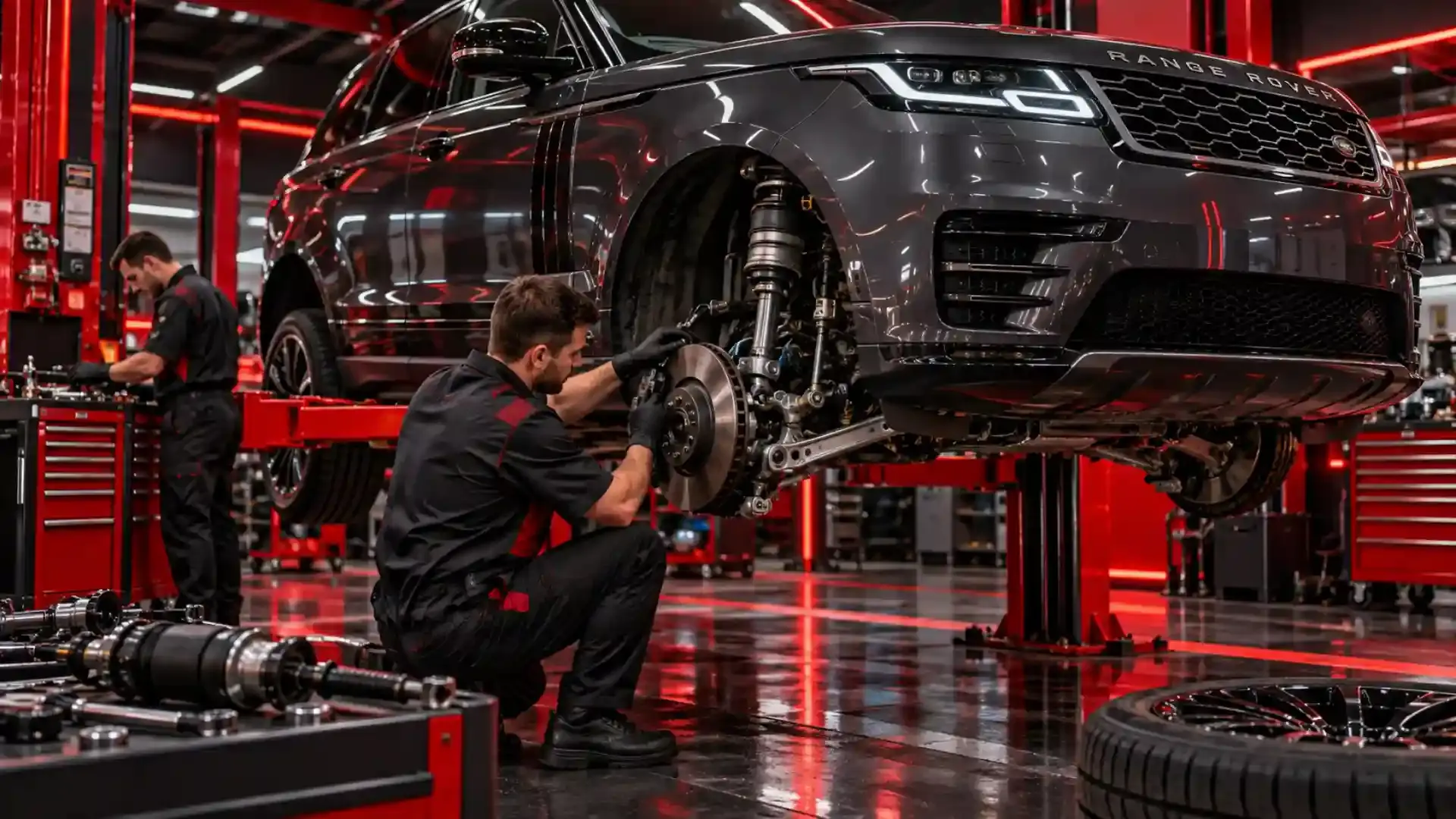
Zenfo Auto Services is the trusted name behind thousands of successful Range Rover suspension restorations across Abu Dhabi. Our team brings together hands-on skill and advanced diagnostic technology to deliver results that match and often exceed dealer standards. Every vehicle that enters our Musaffah workshop gets focused, one-on-one care from technicians who work only on luxury European vehicles.
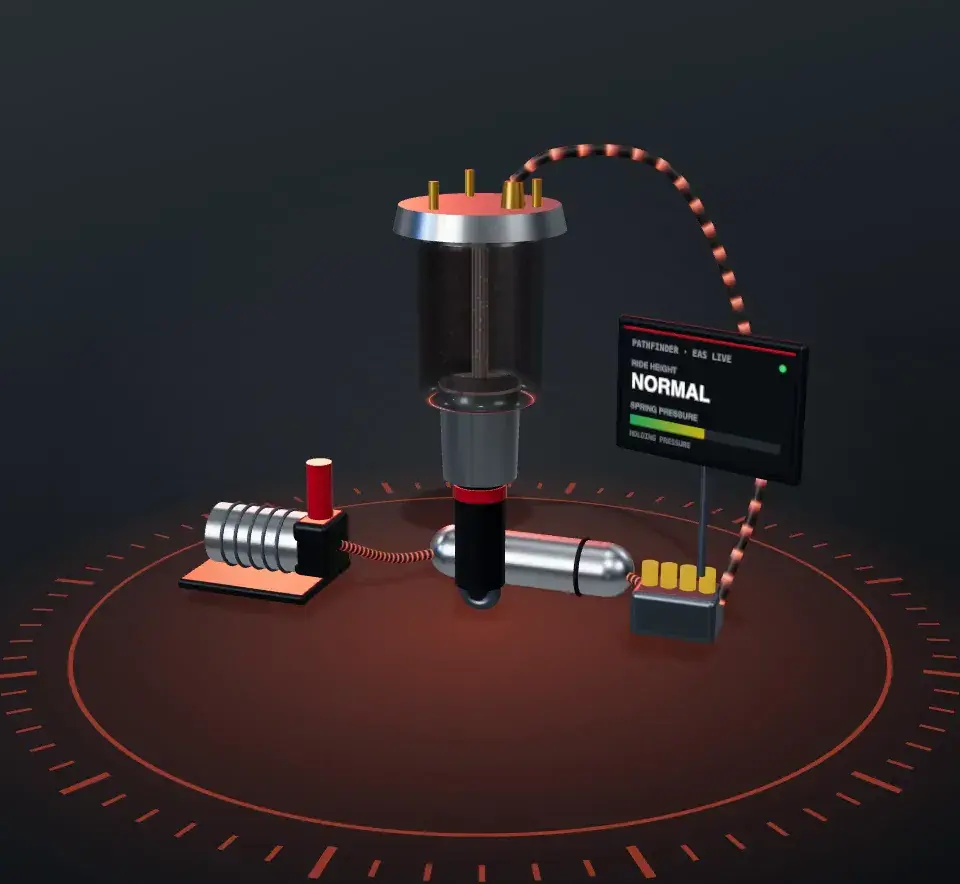
One or more sides of the vehicle sit 20–40 mm lower than normal after parking for 2+ hours. This usually points to a leaking air spring or a faulty valve block.
The “Air Suspension Fault” or “Suspension Inactive” message shows up on the dash. The control module has picked up a reading that falls outside its normal range.
The pump runs loud for more than 90 seconds after you start the vehicle or change the ride height. A pressure leak is forcing the motor to run well past its safe limit.
Choosing Off-Road or Access mode through the Terrain Response menu does nothing. A bad solenoid, sensor, or control module is usually behind it.
Repeated knocking or rattling from the wheel wells when you hit bumps points to worn ball joints, sway bar links, or damaged shock absorber parts.
Feathering, inner-edge wear, or cupping across the tread comes from poor alignment. Shifted control arm bushings or worn ball joints are the usual cause.
The front end dips hard under braking, or the rear drops when you speed up. This means the shock absorbers or struts can no longer control body movement.
Driving with any of these warning signs speeds up damage to nearby parts on your Range Rover. A sagging corner left alone for just 2 weeks often leads to compressor failure. That one ignored fault turns into a full system overhaul costing 5–7 times what the first fix would have been.
A sagging corner left for just 2 weeks often leads to compressor failure, and the bill grows 5–7×.
The system is bled of all pressure and the old spring is removed. A new OEM-spec unit goes in, and all bolts are torqued to Land Rover specs. The system is then re-filled and the ride height is set back to within ±3 mm of the factory target.
±3 mm ride heightThe dryer cartridge is renewed and the motor and piston rings are checked. Worn mounting rubbers are swapped and the exhaust pipe is serviced. A full system purge clears any trapped moisture and brings air output back to the factory-rated level.
Factory-rated outputEach solenoid is bench-tested for seal hold and resistance. Worn O-rings are swapped for factory-spec Viton seals. The full block is then pressure-tested before it goes back in. A complete block swap is the better option when 3 or more solenoids are failing at the same time.
Viton sealsFailed rotary sensors are swapped out, and the control module is reset through the platform's height sensor routine. This locks in the right baseline height-to-voltage reading for each corner so the system pulls accurate data going forward.
Per-corner baselineRusted steel air lines, cracked rubber hoses, and worn push-fit connectors are swapped for OEM-grade parts. Every joint is pressure-tested and leak-checked to fully seal the air circuit that feeds all 4 corner springs.
Every joint leak-checkedSingle-tube and twin-tube damper units are matched to the exact model year. Each is fitted with fresh upper and lower mounting hardware, and all bolts are set to spec. This service targets vehicles where oil bypass inside the damper causes excess body float and weak road grip.
Model-year matchedElectronic adaptive struts are checked through live damping-rate data from the Pathfinder platform. Worn units get swapped for OEM-matched parts and reset on-site so the real-time ride control from Adaptive Dynamics works as it should again.
Pathfinder live dataOn certain L405 and L494 model years, the air spring and damper come as one sealed unit. These are swapped whole to avoid mixing new and worn parts inside a single housing. This protects both short-term ride quality and long-term part life.
L405 · L494Pressed-in or bolted joints are pulled out using Land Rover press tools that protect the control arm bore. New joints go in, and a geometry check follows to confirm correct camber, caster, and toe values at all 4 corners.
4-corner geometryFront upper and lower arms, rear trailing arms, and lateral links get complete bushing kits or full arm sets. A full arm swap is the better choice when rust pitting or bending has weakened the bore and the old arm can no longer hold to spec.
Bushing kits or full armsFront and rear stabilizer bar drop links and bushings are removed, checked, and replaced with OEM-grade units. Final torque falls between 75–115 Nm based on the model year, and the hollow clunking noise during turns goes away for good.
75–115 NmAny part swap that shifts linkage geometry triggers a 4-wheel laser alignment. Target specs come straight from Land Rover's RAVE records to make sure camber, caster, and toe all return to their factory-set values.
RAVE factory specs
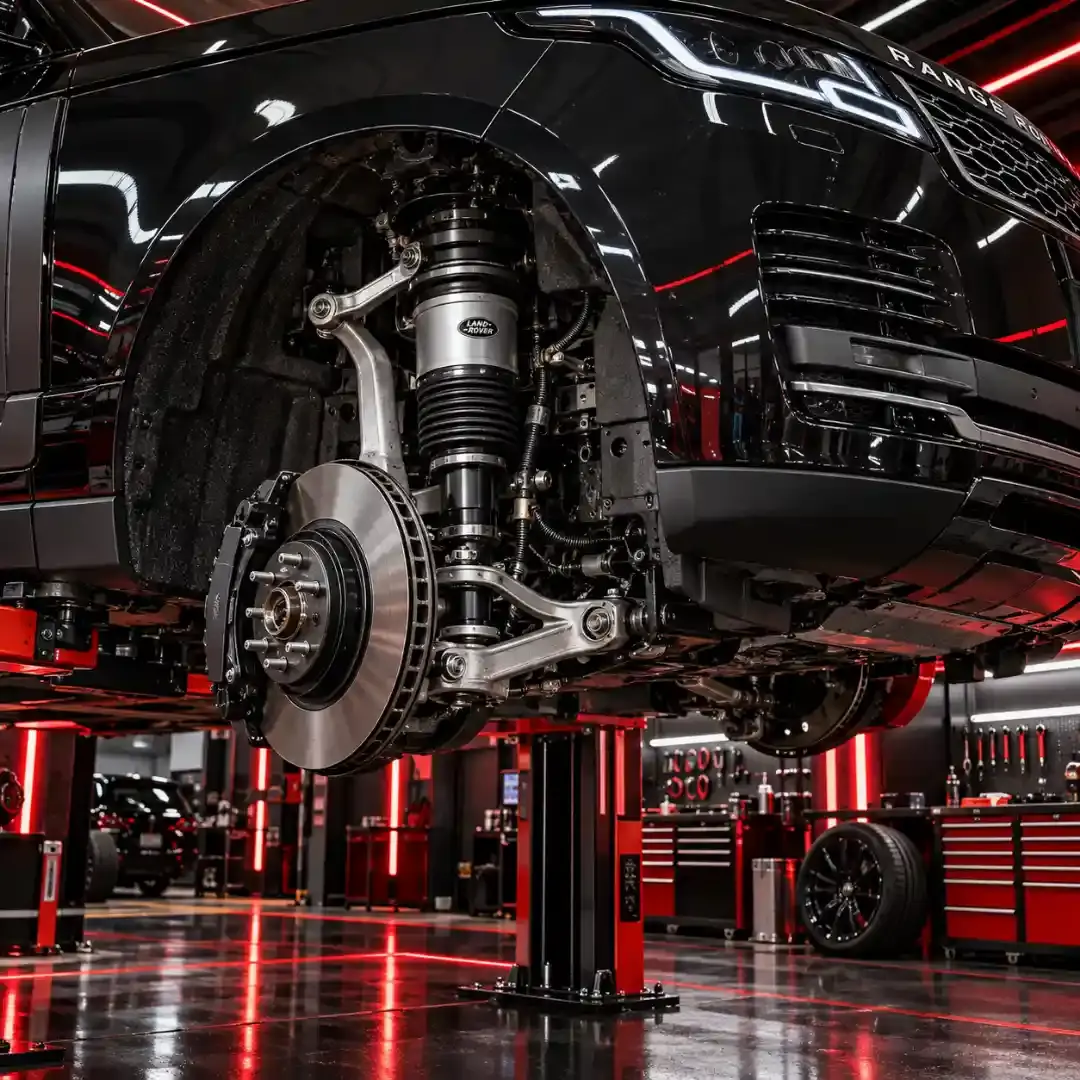
10 years of focused luxury vehicle service in the UAE puts our workshop team among Abu Dhabi's most seasoned independent specialists. That track record spans thousands of completed Range Rover ride system restorations across every model generation.
Pathfinder and SDD platforms give full factory-depth access to EAS fault codes, live data streams, SCM coding, and height sensor calibration routines. Standard OBD-II scan tools simply cannot reach this level of detail.
Every repair quote comes with recorded fault code printouts, live sensor data screenshots, and photos of the failed parts. You see the full cost breakdown and give your approval before any wrench turns.
Front or rear air springs, shock absorbers, and sway bar links always go in as axle pairs. This keeps handling even on both sides and stops the uneven wear that shows up when only one side gets a new part.
Every finished Range Rover goes through a road test covering low-speed turns, highway cruising, and Terrain Response mode changes. The control module is watched for clean operation and correct height shifts before the vehicle goes back to the owner.
Pickup and delivery covers Al Reem Island, Saadiyat, Khalifa City, Mohammed Bin Zayed City, Al Reef, and all nearby areas. No need to figure out transport for a vehicle that has active ride system faults.
Accurate diagnosis stops needless part swaps. Our team follows a 5-stage Range Rover diagnostic check on every vehicle:
The vehicle plugs into a Pathfinder or SDD platform. Stored and pending fault codes are pulled from the control module. Codes like C1A05, C1A18-64, and C1A41 tell us where to look first and guide the rest of the check.
With the engine running, the tech watches live readings on screen. Corner heights, tank pressure, pump run time, and sensor voltages are all compared to factory limits to catch drops in system health before they trigger a stored code.
Soapy water goes across all air spring seams, piston seals, air line joints, and valve block fittings. For slow leaks, the system holds at raised height for 30 minutes. Any pressure drop past 5 mm marks the exact spot where air escapes.
Each part is tested on its own. The compressor is checked for motor draw and output pressure. Valve block solenoids are tested for seal hold. Height sensors get a full voltage sweep, and the dampers are checked for proper rebound and compression.
All findings go into a clear repair list with OEM part numbers, labor hours, and total cost. Every item on the list is backed by the recorded fault data, live readings, and photos of the worn or broken parts.
Abu Dhabi's climate puts every Range Rover suspension part under 3 constant stresses at once:
Temps above 45°C break down rubber in air spring bellows, control arm bushings, and sway bar mounts about twice as fast as in cooler regions. The rubber loses its flex, cracks on the surface, and eventually gives out.
Fine grit works into air spring seals, compressor intake filters, and exposed joints. It grinds down seal surfaces over time and speeds up leak formation at every air connection point.
Coastal moisture eats into steel air lines, reservoir fittings, and sensor linkages. Water builds up inside the air system and damages valve block parts once the dryer cartridge can no longer absorb it.
These three factors together cut the typical Range Rover air spring lifespan from the factory estimate of 80,000–100,000 km down to about 50,000–70,000 km in local conditions. A check at every 20,000 km catches early wear before it spreads into a costly multi-part failure.
A check at every 20,000 km catches early wear before it spreads into a costly multi-part failure.
| Component | Factory Interval | Abu Dhabi Adjusted Interval | 0 – 100,000 km |
|---|---|---|---|
| Air springs (visual inspection) | Every 40,000 km | Every 20,000 km | |
| Compressor desiccant dryer | Every 80,000 km | Every 50,000 km | |
| Shock absorbers / adaptive dampers | 80,000–100,000 km | 60,000–80,000 km | |
| Ball joints | 80,000–100,000 km | 60,000–80,000 km | |
| Control arm bushings | 80,000–100,000 km | 50,000–70,000 km | |
| Sway bar links and bushings | 60,000–80,000 km | 40,000–60,000 km | |
| Ride-height sensors | Replace on failure | Inspect at every service | Checked on every visit |
| 4-wheel alignment check | Every 20,000 km | Every 15,000 km |
Call or message our service desk to book a no-cost Range Rover suspension check for your vehicle. Our team finds the exact fault, gives you a clear price, and brings your ride back to factory-level comfort. Contact Zenfo Auto Services today, Abu Dhabi's trusted name in precision suspension care.
Seeing a suspension warning right now? Our advisors answer the phone and WhatsApp during workshop hours.
Ask an advisor WhatsAppA confirmed leak found through the soapy water test or a 30-minute static pressure-drop test means the spring must be replaced. Rubber bellows cannot be patched once the inner fabric layer is torn. If the leak is coming from the valve block or an air line fitting instead of the spring, fixing that one point avoids a needless spring swap.
A full Range Rover overhaul covering 4 air springs, the compressor, valve block, dryer, and all related seals typically falls between AED 12,000 and AED 25,000. The final figure depends on the model year and whether OEM or OEM-grade parts are used. Single-part jobs start from around AED 1,500 for one air spring and AED 3,500 for a compressor unit with labor included.
Yes. Conversion kits swap the 4 air springs for steel coil springs and bypass all electronic controls. This removes future air system upkeep costs but also takes away height control, Terrain Response tie-in, and auto load leveling for good. Zenfo Auto Services handles both OEM restoration and coil conversion based on what the owner prefers.
The full 5-stage Range Rover diagnostic process runs 90 to 120 minutes from start to finish. Simple, clear-cut faults like a confirmed leaking air spring are often found within the first 30 minutes. Trickier problems that come and go, slow leaks or sensor drift tied to certain temps, may need extended static monitoring.
The Range Rover locks at one fixed height, usually normal ride level, and stops all adaptive adjustment. Driving in this locked state puts extra load on every other working part in the system. That added stress typically pushes a single-part fault into a multi-part failure within 500 to 2,000 km of further driving.